
How AI Is Positively Transforming the Future of Industrial Design
Industrial design is entering a transformative era where craftsmanship and artificial intelligence coexist to create new possibilities. This balance between craft and technology has always been in place, but as AI begins to take a seat at the design table, the balance is shifting, not away from human creativity, but toward a more fluid collaboration between human intuition and computation.
At Vojtek Morsztyn Studio, we're witnessing this creative revolution firsthand. AI has become not a replacement for designers, but a collaborative partner in experimentation and an extension of the designer's vision. It helps us move faster from concept to final form, from sketches to experiences, and from inspiration to realization—all while keeping human sensitivity and emotional intelligence at the center of every project.
This powerful combination of human expertise and machine intelligence is shaping products and systems that are both technically efficient and deeply responsive to human needs.
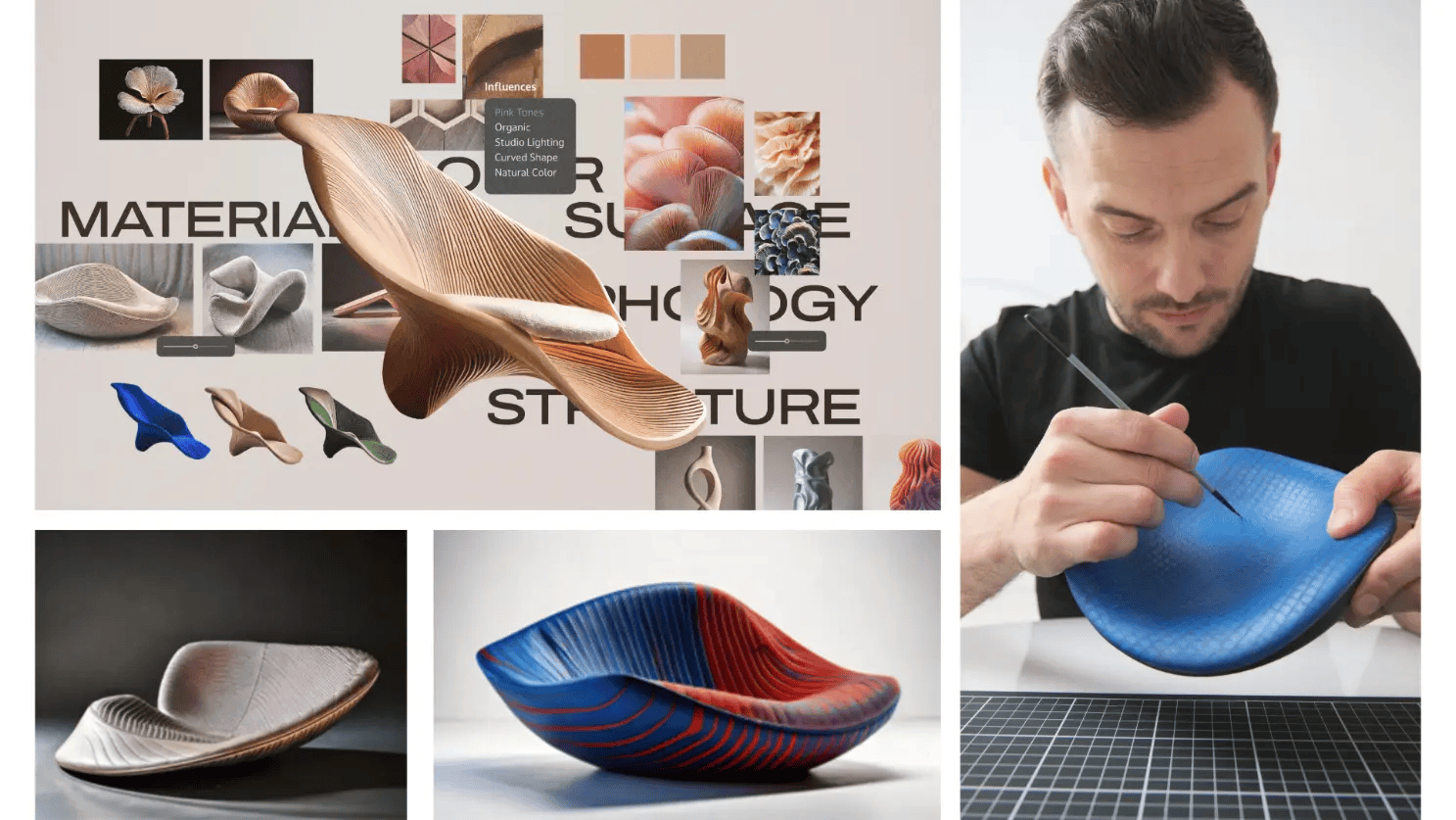
A New Design Language: Rethinking the Role of the Designer
Industrial design has always existed at the intersection of art and engineering. But today, designers are asked to think beyond form and function, and to design complete experiences, interconnected systems, and intuitive interactions that anticipate human needs before they’re expressed.
Artificial intelligence is fundamentally reshaping how we ideate, visualize, and prototype products. What once required days of iterative refinement now unfolds in minutes—though speed is merely a byproduct, not the primary benefit.
Leading AI Tools for Industrial Design in 2025
Some of the modern AI-powered platforms designers can leverage in their toolkit to optimize their design process are:
Generative Design Tools like Midjourney and Krea that are revolutionizing the ideation phase, enabling designers to explore hundreds of aesthetic and functional possibilities rapidly. These platforms excel at visual exploration and concept generation, helping industrial design teams break through creative blocks and discover unexpected solutions.
AI Language Models such as ChatGPT and Claude serve as collaborative thinking partners, helping designers articulate design briefs, generate user personas, refine product narratives, and even assist with technical documentation.
Parametric Modeling Software with AI integration allows for real-time design optimization based on manufacturing constraints, material properties, and performance requirements.
Yet despite these technological advances, the essence of exceptional industrial design remains unchanged: curiosity, intuition, material honesty, and deep user empathy.
In our design studio, we combine these AI-driven ideation tools with traditional 3D modeling, hand sketching, and prototyping. This hybrid process allows us to explore thousands of directions quickly, then refine the ones that speak most clearly to function, emotion, and form.
So, the real transformation in modern industrial design lies not in the tools themselves, but in how designers are learning to think differently about the creative process. The future belongs to those who can navigate both worlds—modeling emotion and precision, art and algorithm, vision and validation in the same breath.
From Sketch to System: The Human Touch in a Digital Design
Even with an AI-driven workflow, the designer’s role remains deeply human: to define meaning and to connect technology with emotion. In our design studio practice, every product still starts with a story—how it’s used, how it feels, how it moves. Then the process often begins by hand, with simple lines and silhouettes that capture movement and feeling. That initial sketch then becomes a digital prompt, a conversation with AI tools that we train to expand, interpret, and challenge our perspective.
Rather than automating creativity, these AI tools function as sophisticated mirrors—revealing possibilities beyond the immediately obvious, suggesting alternatives we might not have considered, and helping us test assumptions quickly. When we design transportation interiors, consumer product systems, or architectural objects, AI accelerates our progression from abstract idea to concrete iteration. However, the designer and human craftsmanship ensure every project maintains functional integrity and meaningful purpose.

“AI is not a shortcut to better industrial design. It’s a catalyst that lets us dream faster and iterate beyond what we thought was ever possible.”
— Vojtek Morsztyn
Our studio approach embraces this duality, balancing artisanal craft with computational power to achieve a modern industrial design process prepared for tomorrow's challenges.
AI-driven Industrial Design
Designing for Emotion and Efficiency
The future of industrial design goes beyond mere performance metrics or technological sophistication. It's about creating spaces and products that feel alive, empathetic, and intelligently responsive to human needs..
Every single object carries its own rhythm and character, like the way its surface catches light, or how the form invites or detracts human touch, or even how a material helps tell a story. These subtle design elements create the emotional dimension of industrial design.
With AI-assisted design integrated in the design process, we can simulate these interactions early in the development process, understanding how users might move, hold, or react long before the prototype stage. This integration of AI simulation, parametric modeling, and human insight produces industrial designs that are simultaneously emotionally resonant and functionally efficient. The result is products that work well and feel right.


The Orchid Armchair invites stillness, comfort, and presence — transforming any space into a moment of calm luxury. It is crafted in small batches to preserve quality and exclusivity. Its unique silhouette transforms spaces, whether a private residence, boutique lounge, or gallery-like interior.
Pre-orders open soon in limited numbers. Join the waiting list for priority access and early previews.
Designing for Sustainability and Longevity
AI is also helping designers make better decisions for the planet, bringing new possibilities for sustainability, not as a visual trend, but as a measurable outcome.
AI-Powered Sustainable Design Methods
Through generative modeling and lifecycle analysis, modern industrial designers can:
Simulate product performance under various conditions
Optimize material efficiency to minimize waste
Reduce environmental impact before manufacturing begins
Test alternative materials virtually
Model circular economy scenarios for product end-of-life
We’re especially interested in how AI can support circular design principles, helping products evolve, adapt, and live longer within new ecosystems of use. This approach leverages technology to minimize waste and reduce material impact while exploring alternative manufacturing methods that are both aesthetically compelling and environmentally responsible.
At its core, sustainable industrial design is about intentional creation: building less, but better. Technology provides the data to support those decisions; craftsmanship provides the discernment to make them meaningful. This represents not merely a design advantage but an ethical shift toward more responsible and regenerative creation. Industrial designers now have both the tools and the responsibility to consider:
Carbon footprint throughout product lifecycle
Material sourcing and supply chain transparency
Modularity for repair and upgrade
Disassembly for recycling and reuse
Longevity through timeless design
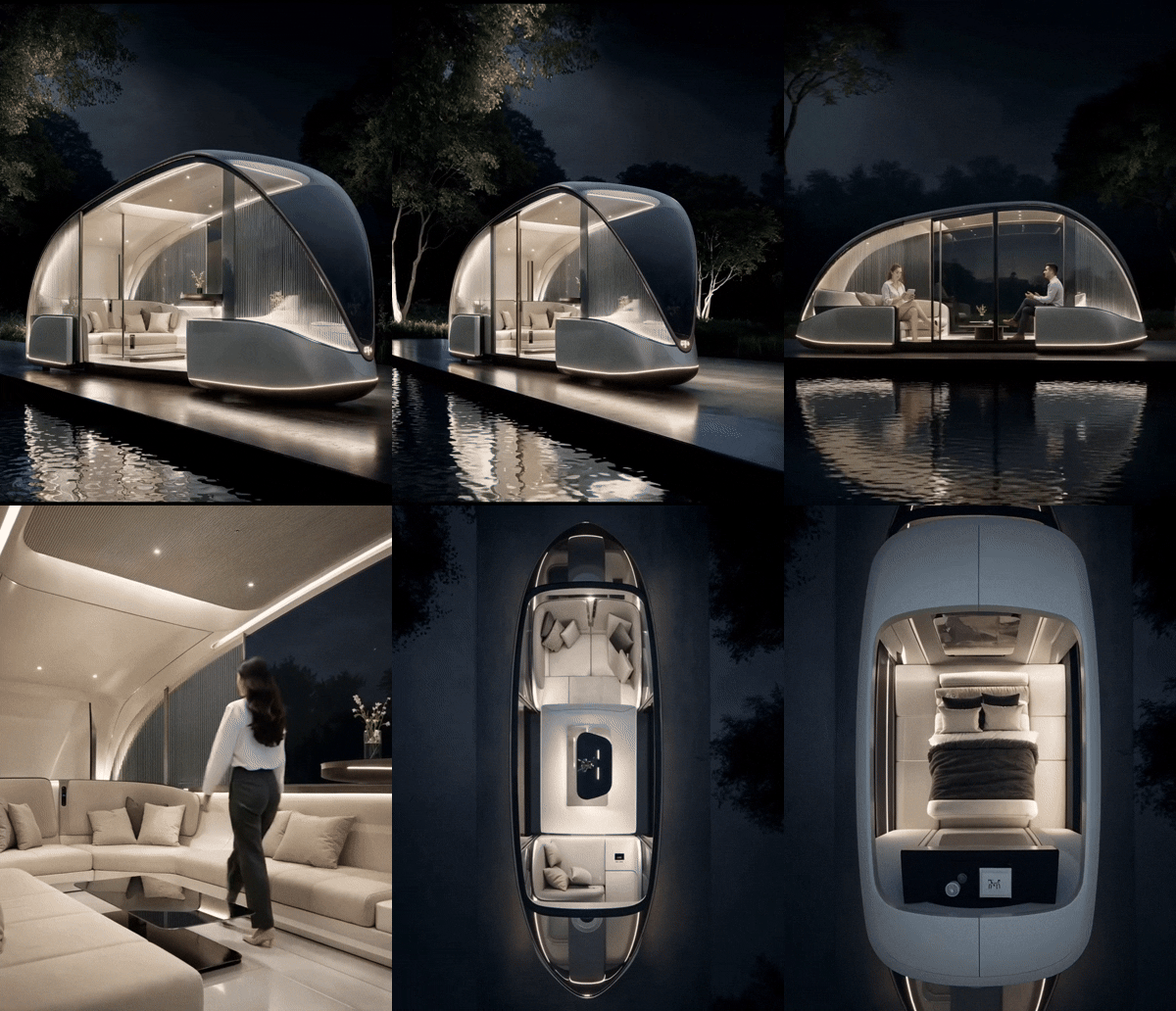
Where the Future of Industrial Design Is Heading
Over the next decade, as AI tools become more sophisticated and integrated, the boundaries between designer and system will continue to blur. AI will become deeply integrated into creative workflows, and industrial designers will move from creating shapes to orchestrating systems, designing relationships between products, people, and data.
For our studio, the challenge—and the opportunity—lies in keeping humanity at the center of this technological evolution. The designer's role will become more fluid and multifaceted, requiring us to balance multiple competencies while maintaining our primary identity as creative professionals. The relationship between designers and AI tools will mature into a true partnership that amplifies our creative touch and enables us to create experiences that are genuinely human-focused, emotionally intelligent, and meaningfully connected to people's lives.
Explore More
Design Portfolio: See our ongoing AI-driven experiments, design studies, and projects.
Resources & Tools: Explore our curated AI design workflows, guides, and downloadable tools.
Work with us: Looking to bring a futuristic design concept to life? Let’s talk.
